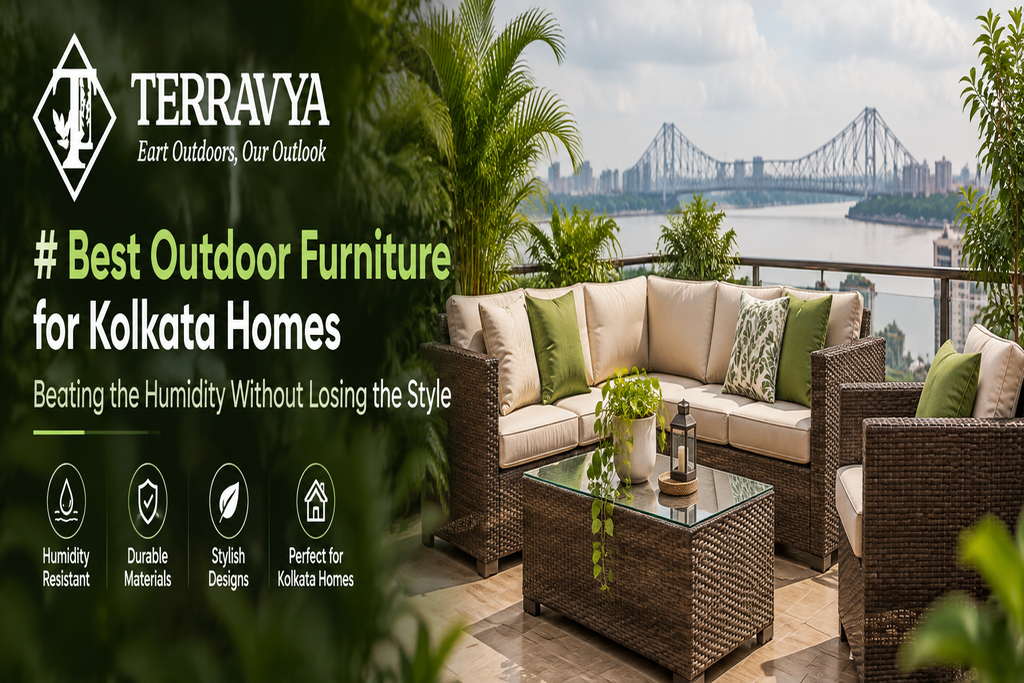
Best Outdoor Furniture for Kolkata Homes: Beating the Humidity Without Losing the Style
A wooden chair left out through one Kolkata monsoon tells you what you need to know. Hairline crack in the grain. Grey bloom of mould where the joints meet. A drawer that used to slide fine and now sticks. None of that is bad luck — it’s what happens when furniture made for a drier place meets a city where the air doesn’t really let anything dry out.
Most people searching for Outdoor Furniture Kolkata are running into a version of this problem without realising it. Furniture labelled “outdoor” in Indian catalogues is usually tested against a national average, and Kolkata sits well past that average — July humidity here runs around 83%, and it stays there for weeks. Before getting into which materials or brands actually work, it’s worth knowing what that number does to a chair sitting on your terrace, and why a set that looked fine in a Bangalore showroom can start falling apart on a Kolkata balcony within a year.
What the Climate Actually Does, Month by Month
IMD-sourced data puts Kolkata’s relative humidity at roughly 51–58% in March, the driest stretch of the year, climbing to 83% by July and August. Annual rainfall runs close to 1,700 mm, most of it packed into June through September. Some days go well past that average — in September 2025 the city logged its third-highest single-day rainfall since 1978. Layer pre-monsoon heat past 40°C in April and May on top of that, and furniture here goes through two rough cycles a year: dry heat, then weeks of saturation.
Wood takes that cycle badly. It swells with moisture through the wet months, then contracts once the air dries even a little. Do that enough times and joints work loose, varnish cracks — it’s the repetition across seasons that does the damage, more than any single storm. Mild steel fails differently: nick the paint or powder coat once, and oxidation starts almost right away in this humidity, spreading faster than it would in a drier city like Jaipur or Pune. Cheap plastic weaves and synthetic wicker hold moisture inside the weave itself, which is usually where that musty smell after a season or two comes from.
There’s also the pollution angle, which most furniture guides skip entirely. Kolkata’s annual PM2.5 average has run in the range of 55–60 µg/m³ in recent tracked years — well into the range international air-quality bodies classify as unhealthy, and multiple times the WHO’s guideline level. That grit settles into fabric weaves and metal joints the same way moisture does. A cushion left out through winter smog picks up a fine layer of soot long before the next monsoon even starts, and that grit works as an abrasive once rain hits it — it’s part of why finishes wear faster here than the humidity numbers alone would suggest, and it’s one more reason wiping furniture down regularly matters more in Kolkata than it would in a cleaner-air city.
None of this means outdoor furniture is a bad bet in Kolkata. It means the humidity figures above should be read as a spec sheet, not background trivia.
The Ground-Floor Problem Nobody Mentions
Balconies and terraces get most of the attention in furniture guides, but a real number of Kolkata homes have some kind of ground-floor outdoor space — a courtyard, a small garden strip, a covered porch — and that space faces a problem balconies don’t: standing water.
Kolkata’s drainage struggles with heavy rain are well documented and not exactly a secret to anyone who has lived through a monsoon here. Low-lying pockets across the city — parts of Salt Lake, Behala, New Alipore, and areas near Ultadanga and Chinar Park among them — see water stagnate for hours after a heavy spell, sometimes longer if the rain keeps coming. If your outdoor furniture sits at ground level in one of these pockets, it isn’t just dealing with humidity and rain landing on it from above — it’s potentially dealing with water rising from below, which behaves very differently.
Furniture legs sitting in even shallow standing water for hours pick up moisture from the base upward, which is a different stress pattern than rain hitting the surface and running off. Raised furniture — pieces with a genuine gap between the base and the ground, rather than ones that sit flush — copes far better here. So does furniture on legs made from a single dense material rather than a hollow tube, since hollow metal legs can trap water inside where it can’t evaporate and quietly rust from the inside out, invisible until the leg gives way. If your garden or courtyard is in a spot that’s ever flooded, even briefly, this matters more than which finish looks nicest.
What Actually Fails First — and What That Tells You
Most outdoor furniture doesn’t fail all at once. It fails at specific points, and knowing where helps you spot a weak product before you’ve paid for it.
On wood, the first sign is almost always the joints — where two pieces are glued or doweled together, since that’s where moisture gets trapped longest and dries slowest. Look for movement or a slight creak when you press on an arm or leg; if it’s already loose in the showroom, monsoon humidity will finish the job fast. On metal furniture, check welds and screw points rather than flat surfaces. Rust starts at a joint or a scratch, not in the middle of a smooth panel, so run a thumbnail along seams and edges before buying. On woven or wicker pieces, the failure point is usually where the weave meets the frame — pull gently at that junction, since a weave that’s starting to separate there will unravel fast once it’s wet and dried out a few times.
This matters more in Kolkata than in a drier city because the failure timeline compresses. A joint that might take three or four years to loosen in Delhi’s climate can loosen in one or two Kolkata monsoons if it wasn’t solid to begin with.
Three Materials, and Why They Hold Up
Aluminium doesn’t rust the way iron or mild steel does. Corrosion needs oxygen to keep eating into bare metal — aluminium blocks that by forming its own thin oxide layer on the surface, so the process stops itself. That’s why powder-coated aluminium frames keep their finish through several monsoons instead of flaking the way cheaper metal does. It’s also light enough to carry indoors when a Nor’wester rolls in without warning, which matters more on a narrow balcony than it sounds like it should. One caveat worth knowing: aluminium welds are only as good as the welder. A poorly welded joint corrodes faster than the surrounding metal, so it’s worth asking whether a piece is welded or bolted, and by whom, rather than assuming “aluminium” alone guarantees longevity.
Polypropylene, or PP, doesn’t absorb water at all, so the whole swelling problem wood has simply doesn’t apply. No rot, no periodic oiling or sealing. UV-stabilised PP also skips the brittleness untreated plastic gets after a year or two of direct sun — worth knowing, since Kolkata’s UV index peaks around 12 between April and August, among the higher ranges recorded in the country. The catch is that not all PP is UV-stabilised; cheaper batches fade and go brittle within a single summer, so it’s worth asking specifically whether the resin used is UV-treated rather than assuming all polypropylene furniture behaves the same way.
Fiberglass turns up more in planters than in seating. It resists moisture better than terracotta and doesn’t split under the same temperature swings that crack unglazed clay. Works fine whether it’s holding a real plant or the artificial greenery a lot of Kolkata balconies switch to after losing one too many ferns to the rains. Good fiberglass planters also weigh far less than concrete or stone equivalents of the same size, which matters on older Kolkata terraces where load-bearing capacity is sometimes a genuine concern, not just a convenience.
Be careful with untreated wood, mild steel without a proper rust-resistant coating, and synthetic wicker that’s only been tested against rain rather than sustained humidity. None of these are wrong choices outright — they just come with upkeep most showrooms leave out of the sales pitch.
Matching Furniture to Your Actual Space
A covered balcony and a fully open terrace face very different weather, even in the same building, so it’s worth being honest about which one you have:
| Space Type | Typical Exposure | Better-Suited Materials |
| Covered balcony | Indirect rain, high humidity | Aluminium, PP, treated wood with care |
| Open terrace | Direct rain and sun | Aluminium, PP, fiberglass planters |
| Garden/ground floor | Rain, soil moisture, some shade | Aluminium, PP, raised planters |
| Semi-open patio | Splash-back rain, seasonal sun | Aluminium, weather-rated fabric with removable covers |
Match the material to what your specific corner actually goes through — not to what looked good under showroom lighting. A north-facing balcony that gets indirect rain but almost no direct sun behaves very differently from a west-facing terrace that takes both the afternoon heat and the brunt of a Nor’wester; the same chair can perform well in one and poorly in the other.
There’s a size dimension to this too, one that’s specific to Kolkata’s older housing stock. A lot of flats in neighbourhoods like Bhowanipore and parts of North Kolkata have narrow balconies with low weight-bearing capacity on the railings and floor slab, since these buildings were designed before outdoor lounge furniture became a common ask. Heavy stone or concrete planters, or bulky sofa-style seating, aren’t always a safe bet on these older balconies regardless of how well they’d otherwise handle the climate. Lightweight materials — aluminium frames, fiberglass planters — solve two problems at once here: they handle the humidity, and they don’t stress a floor slab that was never built to carry much extra load. Newer construction in areas like New Town, Rajarhat, and Salt Lake tends to have sturdier balconies and larger terraces, which opens up heavier options, but it’s still worth checking a building’s load specifications before committing to anything substantial.
Buying Furniture in Kolkata: Delivery, Assembly, and What to Check Before You Pay
Material and design aside, there’s a practical layer to buying outdoor furniture in this city that often gets left out of guides written for a national audience. Kolkata’s older residential buildings — plenty of them without lifts, especially in North Kolkata and parts of South Kolkata’s older lanes — make delivery and carrying furniture up several floors a genuine consideration, not a footnote. A heavy stone planter or a solid wood dining set that needs four people to carry is a very different proposition on the third floor of a lift-less building in Shyambazar than it is in a New Town high-rise with a service lift.
This is a reasonable question to ask before ordering: how is the piece delivered, does it arrive assembled or does someone assemble it on-site, and what happens if it needs to go up a narrow staircase. Lightweight materials like aluminium and PP have a real practical edge here beyond just weather resistance — they’re easier to get up a staircase in pieces and assemble on the balcony itself, which matters more than it sounds like it should when the alternative is a fully built three-seater sofa that won’t fit around a stairwell turn.
It’s also worth asking about warranty terms specific to outdoor use rather than a generic furniture warranty, since a warranty written for indoor furniture often excludes exactly the kind of weather damage a Kolkata balcony sees. A seller who can answer these questions clearly, alongside the welding and UV-stabilisation questions raised earlier, is generally a more reliable one to buy from than one who can only speak to how a piece looks.
Where Terravya Fits In
A lot of “monsoon-proof” furniture marketing in Kolkata treats sturdiness and good looks as opposites — pick one. That doesn’t really hold once you look at what aluminium and PP let a designer do. Aluminium doesn’t need iron’s bulk to stay structurally sound, so a frame can run slim without getting weak.
Terravya, a women-founded outdoor furniture and décor brand based in Tangra, builds around that logic rather than chasing trend cycles. The name comes from Terra (earth) and Avyaan (first light) — the founders’ shorthand for treating a balcony or terrace as a small daily reset instead of dead space. Being based in Kolkata means the pieces get tested against the same humidity and rainfall this piece has been describing, not a generic pan-India spec — a Tangra terrace in July isn’t a hypothetical for the people designing the furniture, it’s the weather outside their own window.
Five collections come out of that, each anchored to one material. Open Air Luxe covers the aluminium range — frames sturdy enough for daily use without iron’s weight, aimed at the kind of terrace or balcony seating that needs to survive a full monsoon outdoors rather than being carried in and out daily. Everyday Ease is polypropylene, for people who want seating that skips the sealing and oiling altogether. Textured Earth handles fiberglass and jute-finish planters, light enough to move but sturdy enough to leave outside year-round, whether they’re holding a real plant or standing empty through the dry months. Evergreen Forms is artificial greenery, aimed at balconies that have given up trying to keep real plants alive through a Kolkata monsoon — a category that exists specifically because so many home gardeners here lose their plants to root rot rather than to heat. Finishing Touches covers the smaller décor pieces that finish a space without a full furniture swap: the kind of detail that turns a functional balcony into one people actually want to sit on.
If you’re comparing Outdoor Furniture Kolkata options across a few brands, it’s worth asking each one the same three questions this piece has already raised — is the metal welded or bolted, is the plastic UV-stabilised, and has the piece actually been tested against Kolkata-level humidity rather than a generic national spec. Not every seller will have a clear answer, and that gap is usually the most useful piece of information you’ll get out of the conversation.
Upkeep Worth Actually Doing
Weather-resistant furniture still wants a bit of attention here, just far less than wood does. Don’t let water sit in joints or under cushions for days — wipe it off once the rain stops. Fabric covers or cushions should dry fast and are worth bringing indoors during the worst monsoon weeks; even “outdoor-rated” fabric wears out faster sitting in standing moisture than it does getting rained on occasionally.
Planters mostly need drainage. Waterlogged soil kills a plant on a Kolkata balcony faster than the humidity itself does. And from June through September, a quick look every couple of weeks — early mould, a rust spot starting, a joint that’s loosened — catches things while they’re still cheap to fix.
One habit worth building specifically for Kolkata: after the first heavy pre-monsoon storm each year, usually a Nor’wester in April or May, do a full check rather than waiting for the season proper. These early storms tend to be sudden and intense rather than prolonged, and they’re often the first real stress test a piece of furniture gets after a dry winter — catching a problem here beats discovering it three months into the monsoon.
Winter, oddly, needs its own small routine too, even though it’s the driest and most pleasant stretch of the year here. The drop in humidity after the monsoon ends is exactly when wood that swelled all season starts contracting again, so this is the window to check for gaps opening up at joints, screws that have backed out slightly, or a finish that’s started to crack as the wood shrinks. It’s also, as mentioned earlier, the period when Kolkata’s air quality tends to be at its worst, so a wipe-down every few weeks through December and January keeps soot from building up on fabric and settling into metal joints before the next humid stretch arrives.
Frequently Asked Questions
Is aluminium really better than wood for a Kolkata balcony? For most homes, yes. It doesn’t absorb moisture the way wood does, so it skips the swell-and-shrink cycle that loosens joints over time. Wood can still work, but budget for more upkeep than people usually expect — treatment and resealing on a schedule, not just when it starts looking rough.
Can furniture sit on a fully open terrace all year? Aluminium and PP handle year-round exposure without much trouble. Fabric is the exception — bring cushions and covers in during the worst monsoon weeks no matter what the frame is made of.
How long does outdoor furniture last here, realistically? Well-made aluminium or PP, kept up as above, holds for several years. Untreated wood or cheap metal usually shows rust, warping, or fading within a season or two, sooner still on a fully exposed terrace.
Does the direction my balcony faces actually matter? More than most people expect. A north or east-facing balcony in Kolkata gets gentler light and less direct monsoon wind than a west-facing one, which tends to catch both the harshest afternoon sun and the brunt of Nor’westers coming in from that direction. The same piece of furniture can wear differently depending on which way it’s facing.
Is it worth paying more for a branded set over a local carpenter’s version? Not automatically — a skilled local carpenter using treated wood and proper joinery can build something that lasts. The difference usually comes down to whether the maker actually accounts for Kolkata’s humidity in the material choice and joinery, rather than the label on the product. Ask about the specifics rather than the brand name alone.
Does Terravya deliver across Kolkata? Yes — based in Tangra, working across the city’s balconies, terraces, and gardens. Current collections and delivery details are at terravya.in.
What about furniture for a ground-floor garden that sometimes floods? Raised furniture with a real gap beneath the base handles this far better than anything sitting flush with the ground. Solid legs also beat hollow tubing here, since a hollow leg can trap water inside where it rusts unseen. If your outdoor space has ever taken in standing water, even briefly, it’s worth mentioning that specifically to whoever you’re buying from, since it changes which pieces make sense.
Is my building’s balcony strong enough for heavier outdoor furniture? Worth checking before buying rather than after. Older buildings in parts of North and Central Kolkata were generally not designed with lounge-style outdoor furniture in mind, and railings or floor slabs may have lower load limits than newer construction in areas like New Town or Rajarhat. Lightweight materials like aluminium and fiberglass sidestep this concern almost entirely.
What It Comes Down To
Buying outdoor furniture for a Kolkata home is really one question: does this material’s spec sheet match what the city’s humidity actually does, or was it tested somewhere drier? Aluminium, PP, and fiberglass hold up better here for chemical reasons, not brand reputation, and knowing where a piece actually fails first — the joint, the weld, the point where a weave meets its frame — tells you more about its odds of survival than any warranty card will. A balcony in Salt Lake and a terrace in Alipore both sit through the same 83% July humidity, regardless of budget or square footage, so the material and construction quality matter more than the style. It’s the same thinking behind how Terravya approaches the Outdoor Furniture Kolkata buyers are actually looking for: climate first, construction second, and the look follows from what the material can actually do.
Climate figures referenced below are drawn from India Meteorological Department (IMD) data as compiled by climate-tracking sources including Wikipedia’s Climate of Kolkata and Weather Atlas; readers requiring citation-grade figures should verify against IMD’s own records.