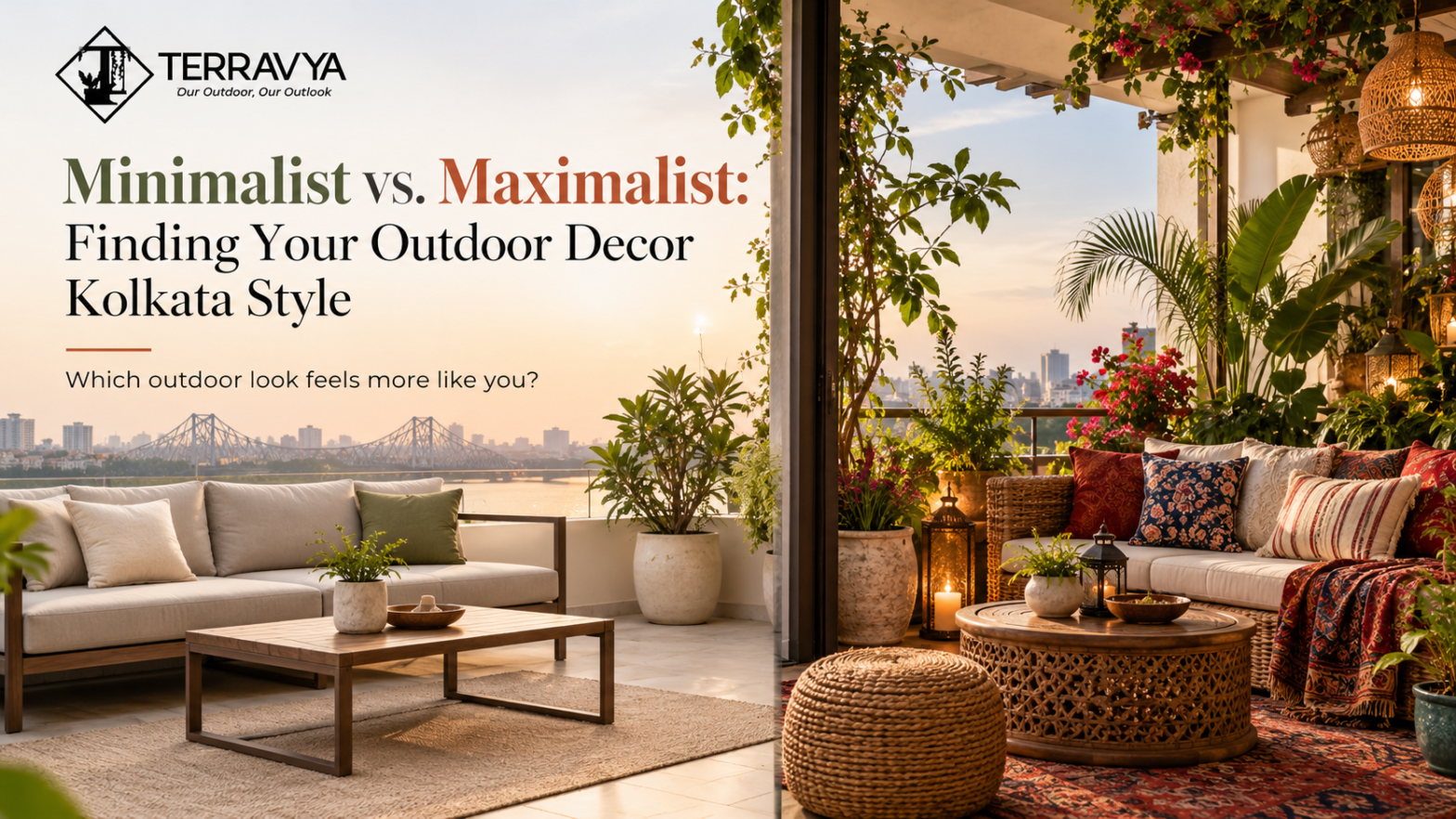
Minimalist vs. Maximalist: Finding Your Outdoor Decor Kolkata Style
It’s October, one slow sunday morning, rain finally wrapped up for the season and the whole area fills up with the smell of wet earth and somewhere air is getting filled with the aroma of frying puris somewhere. You carry your tea out to the balcony and realise there’s nowhere to sit, unless you count the plastic stool or the tulsi that didn’t make it through August.
This is more or less the moment people start typing Outdoor Decor Kolkata into a search bar, and the results can be disappointing, because plenty of the photos show patios in places where the rain is a lot better behaved than ours.
We’re Terravya and we sell outdoor furniture, so keep that in mind as you read. Still, the question hiding behind all those photos doesn’t cost anything to answer. Do you want your outdoor space almost bare and clean, or layered and busy? Minimalist or maximalist, in other words, which in plenty of families turns into a proper argument. We’ll try to settle it.
What do minimalist and maximalist actually mean outdoors?
These two words are used by people very loosely. So for this guide the minimalist way of decorating a balcony will be within three to six things on it, pots will be there, with a patch which will be left empty for some space. For maximalist one, the things will be more ,maybe a dozen, which normally includes throws, cushions, with few lanterns and plants of different heights, all kept on purpose. There’s no official count (we chose these ourselves), but without some number the whole debate is just people saying cluttered and boring at each other.
Designers don’t agree on it either. A [2026 outdoor design roundup from Centris](https://centris.ca/en/blog/tips-and-decor/10-dreamy-outdoor-design-trends-for-2026 ) describes maximalism as a confident answer to design that had become too minimal, while a [landscaping piece on AOL](https://www.aol.com/articles/7-landscaping-trends-goodbye-2026-130000421.html ) quotes a designer who finds all-neutral yards flat and would rather bring colour in through cushions, pots and rugs. Both are written from North America, though, so they’re good for a mood and not much use as instructions for a Kolkata flat.
What the monsoon does to all this
The [Climate of Kolkata page on Wikipedia](https://en.wikipedia.org/wiki/Climate_of_Kolkata ) gives annual rainfall of about 1,711 mm, most of it falling between June and September, and its 1991 to 2020 averages for the Alipore station put humidity at 5:30 pm at 82 to 83 percent from July through September. Before that, in April and May, there’s Kalbaishakhi, the thunderstorms that arrive from the north-west with hardly any warning.
If you are living here for long, you are aware of this already, but it is very rare this thing comes to mind when someone is buying furniture. So the effects fal on the cushion which is damp and giving foul odour during breakfast time, the doors of the wooden balcony feels sticky and swell, iron made products turns orange, and the rug made of jute having a smell which take days to go.
The test we use is simple and a bit unglamorous. Imagine it’s quarter to five on an April afternoon and the sky over the north-west has gone nearly black, and you have to get everything that mustn’t get wet indoors: the cushions, the rug, the lanterns, the book somebody left open on the arm of the chair. If that takes one trip, no problem. If it takes two or three, you probably want fewer things, or a lidded box to tip them into, and if it takes more than that you’ll most likely give up on the whole routine by the second week and the cushions will spend the monsoon outside.
Small balcony: minimalist usually wins
Take a tape measure before anything else. A chair depth ideally should be 70 cm, and you may want 60 cm to pass it, and if you take a round table, it is minimum 50 to 60 cm, so need to add those also. And now if these total exceeds the total depth of the balcony, you should avoid the table and keep the walkway. These are planning figures may not be suitable for all, so measure it with your own furniture.
What you get in return for having less is the chance to spend properly. With four things instead of fifteen you can pay for a better frame and better cushions, and there’s very little to wipe down after a dusty week in March. If we had to choose between a third chair and a warm lamp we’d take the lamp, which is only our opinion, but a cheap lamp changes an evening more than most furniture does.
The place minimalism usually falls down is visitors. A single chair may be suitable for any day until the day your friends arrive and you can see all are standing with their cup of tea. So it is wise to keep a pair of stackable chairs as a backup, or a bench in storage, which will come in handy without cluttering the space.
Terrace or garden: maximalist works, with some care
If you are living in an old house, likes of which can be found in Ballygunge, Behala, or Alipore,those who have a veranda, a garden or a terrace, there are spaces where you can style it in locally, anyway by keeping terracotta pots, Kantha sheets, a cane stool or a brass lamp, it also suits local style and a vintage feeling. Put together they look like somebody’s home rather than a showroom.
The catch is water. Each pot sits in a saucer, and a saucer holds water that has nowhere to go. San Diego County’s [vector control guidance](https://www.sandiegocounty.gov/content/sdc/deh/pests/wnv/prevention/backyardsources.html ) says to empty plant saucers at least once a week, because mosquitoes can grow from egg to biting adult in under a week, and Aedes, the group that includes dengue carriers, breeds in very small amounts of water. Choosing a day (Saturday morning is as good as any) helps it become routine, and fine gravel in the saucer or small feet under the pot cut the problem down further.
Wet soil also weighs a lot, so before you line big ceramic pots along the edge it’s worth asking the builder or housing society about load limits and railing rules, if only because the society WhatsApp group will find out anyway. The same applies to a swing or hanging chair: someone qualified should look at where it’s fixed, because a hook that happens to be in the ceiling isn’t necessarily meant to take a person.
Side by side
| Factor | Minimalist | Maximalist |
| Typical item count | 3 to 6 including planters | 12 or more |
| Storm clearing (our rule of thumb) | One trip | Two or three trips, or a lidded box |
| Weekly upkeep | Wipe frame and floor | Wipe, empty saucers, dry textiles |
| Best suited to | Balconies under about 1.5 m deep | Terraces, verandas, gardens |
| Where it usually goes wrong | Too few seats for guests | Textiles left out, mildew, standing water |
| Where the money goes | Frame and seating | Accessories, replaced over time |
What to look for when you buy
Wherever you are buying from, check the frame , what is it made of, the finish, and the screws from which they are made out of, these seems very cheap may be, but they are important wehn you are living in a humid city, these three answers are more practical than rest of the things you will ask for later.
Powder-coated aluminium has no iron in it, so it won’t go red with rust, although the coating can chip and bare aluminium turns chalky, so touch up a chip when you notice it. Teak copes outdoors because of its natural oils and, left alone, ages to a silver-grey that plenty of people like; if you’d rather keep the honey colour, many makers recommend oiling once or twice a year, and the care sheet will say. Woven HDPE resin doesn’t soak up water, but check that it has a UV stabiliser, since the cheaper versions fade and can turn brittle in strong sun. Natural cane is the material that suffers most, because it takes on moisture and goes mouldy if it’s left out through a monsoon, so it needs a roof.
The small parts matter as well. Stainless steel screws (304 is a common grade) last far longer than plain steel, and cushions are better with quick-drying foam and covers that unzip. We’d skip glass tabletops, since every dried raindrop shows, and be wary of white cushions, where mildew is so easy to spot. A very light chair on a high floor can also slide or tip when a nor’wester comes through, so it’s worth lifting one before you buy.
At home, measure the door swing as well as the floor, since a set that stops the door opening will have to go back, and after a heavy shower go and look at where water collects and which way the floor slopes, because table legs and rugs sitting in a puddle rot. And try not to go all natural fibre. A jute rug, a cane chair and cotton cushions look lovely together, and every one of them holds water.
So which one are you?
Before settling on an Outdoor Decor Kolkata style it helps to write down three answers: how deep the space really is once you’ve left a walkway, how much of it sits under a roof or a deep overhang, and how many minutes a week you’ll actually spend looking after it (the real number, not the one you’d like to say out loud).
As a rough rule of ours, a space under about 150 cm deep, mostly open to the sky, with 15 minutes a week or less to give it, suits minimalist, while a big area that’s mostly covered and gets 30 minutes or more suits maximalist. If you land somewhere in between, the next section is for you. Which way the space faces counts for something too: a west-facing balcony gets direct sun late in the afternoon, and dark fabric there fades faster and gets too hot to sit on.
What we’d do on most balconies
Most of the time we’d buy the base once, meaning weatherproof furniture in a calm colour, a few plants that can handle the weather and one warm light, and keep everything else in a lidded box: the rug, the cushion covers, the lanterns and the marigold garlands for when relatives come at Puja.
October happens to be a good time to start. The monsoon has gone, Puja is close, and you have until the April storms to find out what works. The box comes out when people visit and goes back afterwards, and in June you swap to covers that wash easily and leave only the base outside.
Frequently asked questions
What suits a small balcony?
Minimalist, in nearly every case. There’s rarely room for layers, so put the personality into one large planter and a patterned cushion cover.
Which materials survive the monsoon?
Powder-coated aluminium, teak and HDPE woven seating, all fixed with stainless steel screws, cope well. Natural cane needs a roof.
How do I stop cushions going mouldy?
Let them dry completely before they go in the box, and don’t seal them in plastic while they’re damp. A box with some ventilation is better than wrapping.
How much of the budget should go on seating?
A reasonable starting point is about two thirds on seating and the table, and the rest on lighting and textiles, adjusted if you already own seating you like.
Can I hang a swing on my balcony?
Only if the fixing point is rated for it, which means asking your builder or society and having a qualified person check the anchor before anyone sits in it.
Conclusion
. Whatever the choice may be, minimalist, maximalist or something balanced from both, choice should be keeping the monsoon and humidity in mind. Run with the quarter to five test before spending a rupee,It is a dull exercise may be, but it will inform you more about your Outdoor Decor Kolkata plans less than a month of stored photos. Measure properly, choose materials that are happy in the rains, and keep the decoration items handy so that you can pick them up indoors whenever necessary.
If you’d like help matching furniture to your balcony, terrace or garden, explore the Terravya outdoor furniture collection or get in touch with our team for advice on sizes, materials and layouts.