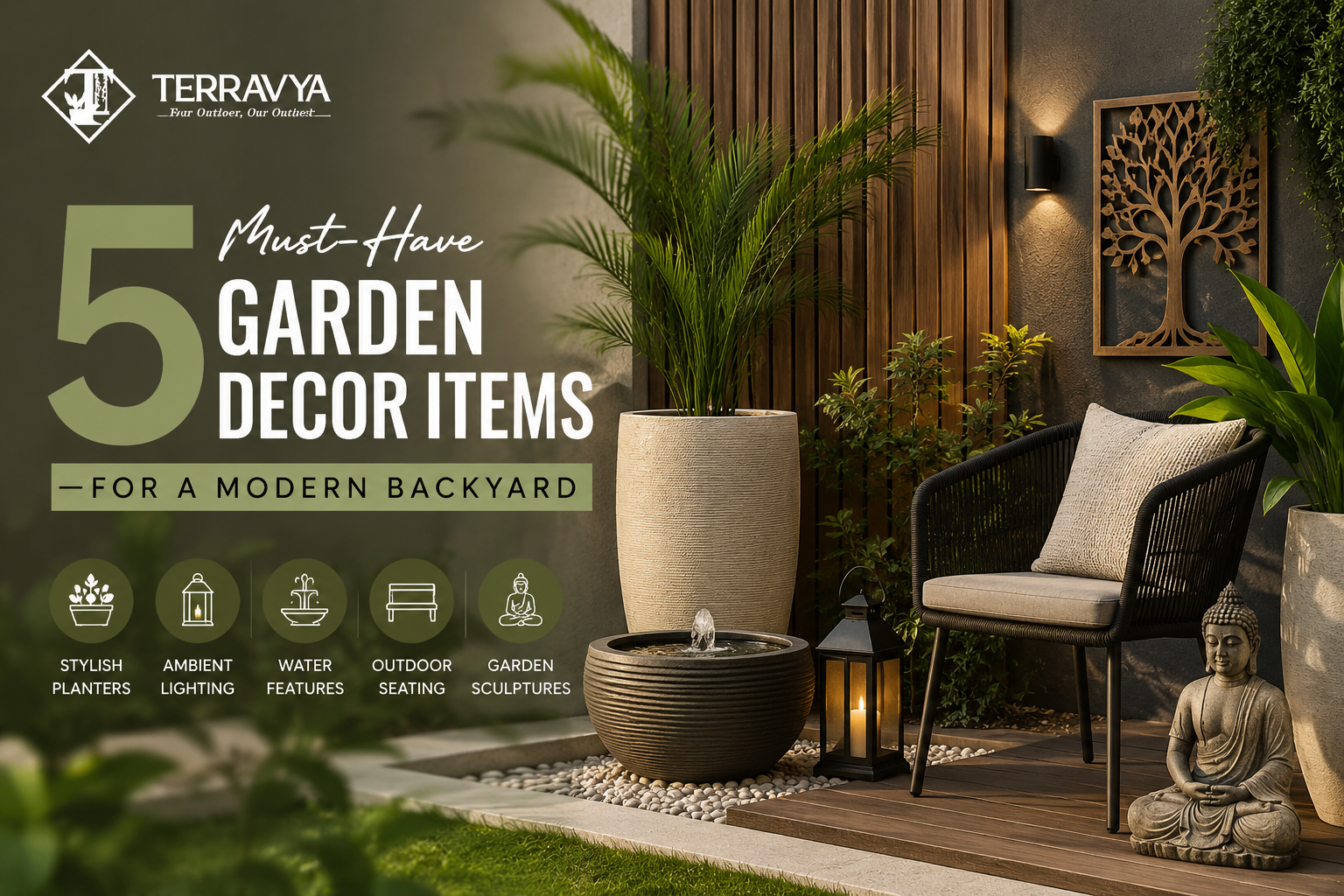
5 Must-Have Garden Decor Items for a Modern Backyard
A few years ago, “decorating the backyard” in most Indian homes meant one plastic chair, a couple of nursery pots that eventually died anyway, and calling it a day. That’s shifted. We hear it every week at Terravya’s showroom in Tangra, Kolkata — fewer people asking what’s cheapest, more asking whether something will actually make it through June.
That question is basically the whole story. Monrovia Nursery ran a 2026 consumer survey covering over 1,400 homeowners and found something a little unexpected — container gardening interest is growing fastest among people 65 and older. Not who you’d guess is driving a design trend, but they’ve got the time and the money to spend on it properly. The Pennsylvania Horticultural Society’s 2026 report points somewhere similar: after years of minimalism, outdoor spaces are swinging back toward “maximalist” — more colour, more texture, less holding back.
None of that tells you what to actually buy, though. So below are five categories of garden decor items worth spending on this year, plus the mistakes we keep watching people make, based on what’s held up in our own inventory and what’s come back damaged within a season.
What’s Actually Different About This Year
There are three things pushing this, honestly. People are just home more than they were five years ago, so a balcony stops being storage and starts being a room you actually sit in. Instagram and Pinterest did their part too — “well-designed outdoor corner” used to be a vague idea, now it’s a specific look people screenshot and try to recreate. And materials caught up. Aluminium furniture, UV-stabilised polypropylene, fiberglass planters — they get through an Indian summer into monsoon now without the warping and colour loss that cheap stock used to suffer within a year.
That last bit matters most if you’re actually spending money on this. A piece that photographs beautifully in a showroom but goes patchy by August wasn’t a good deal, whatever it cost.
1. Planters Chosen as Objects, Not Containers
Planters give you the most visible payoff for the least money out of everything on this list. Put one good, tall planter in a corner and suddenly everything around it looks arranged instead of scattered — that’s really the whole trick.
Fiberglass has mostly taken over from plain terracotta, and there’s a practical reason for it. Terracotta chips at the rim once it’s been moved around a few times, and it soaks up water — which adds weight and, over a hard monsoon, can crack the pot from the inside. Fiberglass just doesn’t do that. It’s lighter than concrete too, by quite a bit, which matters more than people think once you’re working with a terrace or balcony that has an actual weight limit rather than open ground.
Here’s a habit worth stealing: group three planters at different heights instead of using one big pot on its own, or lining several up in a row. Uneven groupings look intentional. Matched rows look like inventory sitting there. Small difference, big effect.
If you’re starting from nothing, planters are the easiest place to begin — one decent piece changes a bare corner without you having to commit to redoing the whole space.
2. Artificial Greenery, Used Where Real Plants Won’t Cooperate
People push back on this one first, and I get it. But usually what they’re picturing is old artificial plants — stiff, too shiny, obviously plastic. That’s not what’s out there now. UV-treated versions hold their colour in direct sun and don’t go brittle in humidity the way the older ones did, and the decent ones have enough variation in the leaves that you’d have to actually touch one to be sure.
The honest use case here isn’t replacing real plants — it’s covering the spots real plants just can’t handle. A north-facing railing that gets two hours of light. A corner nobody remembers to water for a week. The gap between two real pots that would otherwise sit empty for a season. Mix them in properly and most people won’t spot which is which without checking.
If you want that “always full” look everyone’s writing about this year, without committing to daily watering, this is the practical version of it. Not a design philosophy — just a shortcut that happens to look good.
3. Furniture That Was Actually Designed to Sit Outside
This is where most people lose money, and it usually goes the same way: an indoor-style wooden chair gets bought on sale, warps or grows mould after one monsoon, gets replaced — and at that point the “cheap” option ends up costing more than just buying the right thing the first time.
Aluminium holds up because it doesn’t rust the way iron does, and the powder-coated finish resists fading for years, not months. It’s a lot lighter too, which actually matters if you need to drag furniture indoors before heavy rain. Polypropylene’s the other decent option — lighter still, cheaper, handles sun and water fine, though it won’t ever feel as solid as aluminium or hold a finish quite as well.
Try not to fill an entire terrace with mismatched pieces picked up over time. One good two-seater and a small side table, positioned to catch morning light, does more for how a space gets used than five random pieces scattered around the edges.
4. Lighting, Because Most Backyards Just Go Dark
Walk down any residential lane after 8 pm and count how many balconies are actually lit for something other than security. Not many. Most run on a single bulb or nothing at all, which means the space someone spent money decorating basically disappears the moment the sun’s down — right when most people finally have time to sit in it.
Three light sources sort this out without needing an electrician: something ambient, like string lights or a lantern; something functional near wherever you’d actually eat or read; and one or two accents aimed at a planter or a wall so the space has some depth after dark instead of just going flat. None of it costs much compared to furniture. It just gets skipped, mostly because it’s the last thing anyone thinks about.
Solar’s come a long way too — good enough now that renters, or anyone who can’t run new wiring, can put together a decent layered setup in an afternoon.
5. The Small Stuff People Notice Without Naming
Trays, a sculptural piece, a textured cushion, something on the wall — nothing in this category has one specific job, but you’ll notice when it’s missing, even if you can’t say exactly why the space feels off.
The PHS’s 2026 report calls it a pull back toward “maximalist” styling after a long stretch of minimalism — colour and texture coming back, but on purpose this time, not just piled on. What that means practically: one bold cushion or one sculptural piece beats ten little trinkets bought here and there. Pick two or three finishing pieces that share a colour or material and leave it at that. Buying these one at a time, with nothing tying them together, is probably the single biggest reason a backyard still looks unfinished even after real money’s gone into it.
Buying Mistakes We See Most Often
A handful of mistakes cause most of the wasted money we see when people pick out garden decor items without much of a plan. None of them are hard to avoid once you know to look for them.
First one’s sequencing — buying the fun stuff before the structural stuff. Solar lights bought before there’s a single planter or chair in place don’t have anything to actually light up. Structure first, atmosphere after.
Second, buying for a season instead of a climate. A rattan-look chair or an untreated terracotta pot might make it through a mild autumn just fine, then fail completely the first time it sits through a full monsoon. If a product’s durability claim doesn’t mention sun and water together, it probably wasn’t tested for conditions here.
Third — matching everything instead of layering it. Buy a whole furniture set, a matching trio of planters, identical cushions, all from one collection, and you end up with something that looks like a catalog page rather than a room somebody actually lives in. The backyards that actually photograph well tend to mix at least two textures — metal against fiberglass, say, or fabric against stone — instead of sticking to one material throughout.
Fourth, and this one gets expensive: skipping the load and drainage check before buying anything heavy. Concrete planters and dense stone furniture look impressive, but plenty of older balconies and terraces around Kolkata weren’t built to carry that kind of sustained weight. Checking the load capacity first takes five minutes and saves you from a genuinely costly mistake later.
Where to Actually Start
None of these five categories really stand alone — a planter with no lighting still disappears after dark, and furniture with no finishing layer just looks like a showroom floor rather than somewhere someone actually sits. But you don’t need all five right away. Start with planters and one piece of furniture, live with that for a season, then bring in lighting and accents once you actually know how you use the space, not how you imagined using it while shopping. Honestly, the mistakes above matter more than what order you tackle these in — get the sequencing and the climate-fit right, and the rest comes down to taste.
The one rule that holds across all five: buy for the weather you actually have, not the photo you’re trying to recreate. A planter or chair that looks right in a showroom but fades by August was never a good deal, regardless of the price on the tag.
Terravya’s own collections follow that same logic when it comes to sourcing garden decor items — Textured Earth for planters, Open Air Luxe for aluminium furniture, Evergreen Forms for greenery — all built around Kolkata’s climate rather than a generic catalog spec. If you’re planning a backyard refresh this year, that’s a reasonable place to start comparing what actually fits your space.
Frequently Asked Questions
What should I buy first for a backyard makeover? Planters, honestly, then a piece of seating. Both show up right away and don’t depend on anything else being in place — lighting and the smaller accents make a lot more sense once you already know how you’re using the space.
Does artificial greenery actually work outdoors, or does it look cheap? Depends entirely on the quality. Good UV-treated versions hold their colour through sun and monsoon and read as real from a normal distance. The older, untreated stuff fades and goes brittle within a season — that’s really what people are picturing when they say it looks cheap, and it’s not a fair comparison anymore.
Aluminium or polypropylene — which should I actually get? Aluminium if the budget stretches to it. Heavier, holds its finish longer, feels more solid underfoot and under hand. Polypropylene’s the sensible fallback if weight or price is the limiting factor — it still handles sun and rain without issue, just without quite the same heft.
Do I need a designer, or can I do this myself? You can do it yourself. Pick one corner, get the planter and the seating right, sit with it for a season, then expand outward from there. Trying to finish an entire backyard in a single pass is usually where people overspend and still end up unhappy with how it turned out.
Author: Terravya Design Team Reviewed by: Terravya Product & Sourcing Team Terravya is based in Tangra, Kolkata, and designs outdoor furniture, planters, and decor for balconies, terraces, and backyards across India.