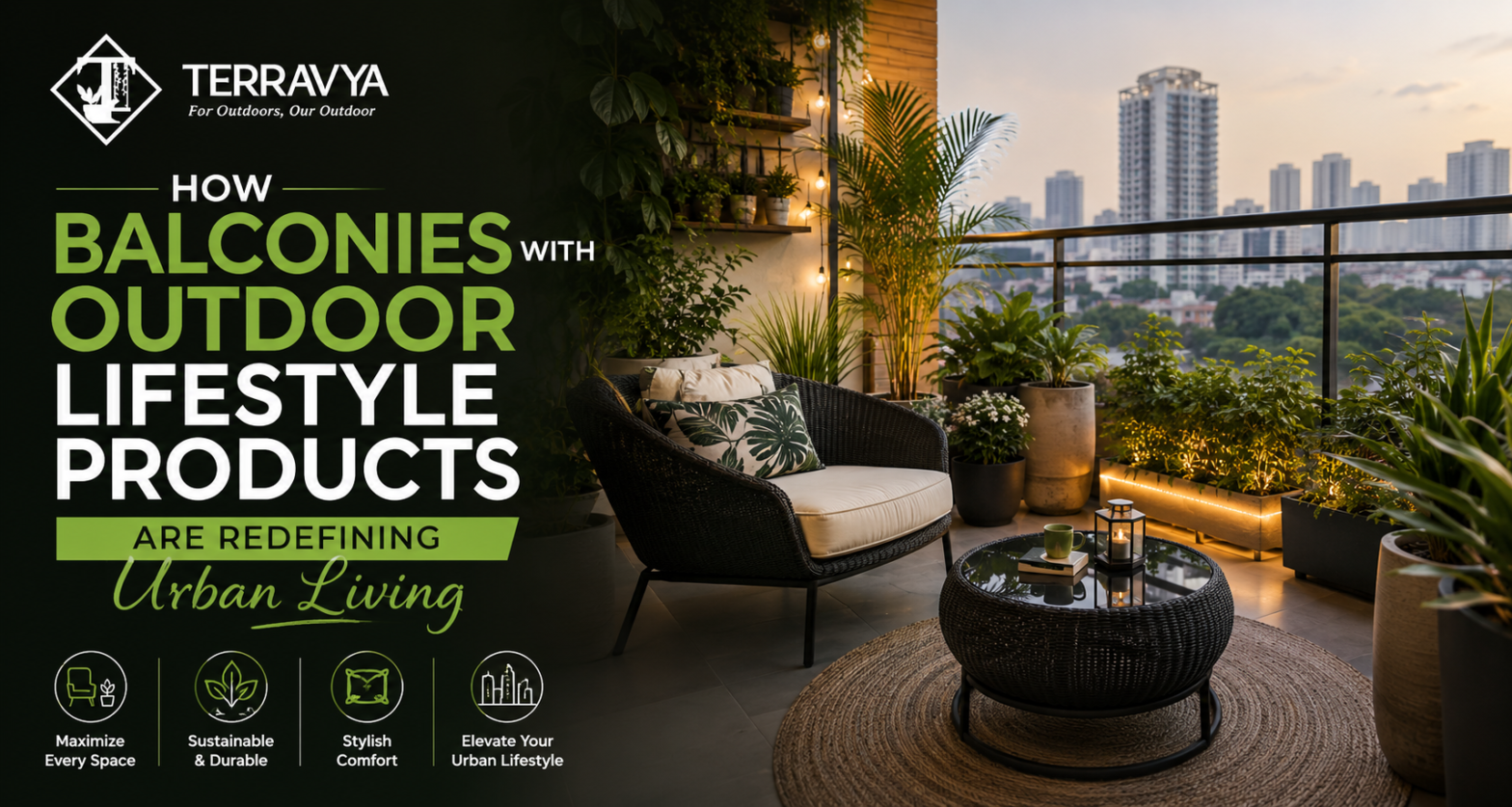
How Balconies with Outdoor Lifestyle Products are Redefining Urban Living
There’s a version of this article that opens with “Indian homes are shrinking, so balconies are becoming precious.” It’s the line every furniture blog reaches for. It’s also wrong, at least right now. Anarock Research tracked average apartment sizes across India’s top seven cities rising from around 1,420 sq ft in 2023 to nearly 1,676 sq ft in 2025, a 17% jump in two years, led by Hyderabad, Bengaluru, and NCR. Mumbai’s metro region is the outlier, still the tightest market in the country at roughly 900 sq ft. So the real story isn’t about less space. It’s about what people are choosing to do with the space they already have, and increasingly, that includes the balcony. That’s the shift behind the recent rise in outdoor lifestyle products across Indian cities, and it’s worth understanding before you spend money assuming the wrong reason.
At Terravya, we design furniture and décor specifically for balconies, terraces, and patios, so this isn’t a trend we’re reading about from a distance. It’s the demand we build against every season, and it’s changed noticeably even in the time we’ve been doing this.
The Real Reason Balconies Got Busy
Hybrid work is the more honest explanation than square footage. When part of your week is spent at home, the balcony stops being a pass-through and starts competing with the living room for actual use, a second call spot, a place to eat breakfast before the day gets loud, somewhere to sit that isn’t the same four walls you’ve been staring at since 9 a.m. Nobody plans this consciously. It happens because the living room already has a TV schedule, a dining table with someone’s laptop still open on it, and a couch that’s been claimed. The balcony is the one surface in the house without a prior claim on it.
There’s a market number that backs this up better than any lifestyle claim could. Grand View Research puts India’s outdoor furniture market at roughly USD 2.30 billion in 2025, projected to reach USD 4.13 billion by 2033, growing faster than any other country in the Asia-Pacific region. That’s not people replacing broken chairs. That’s a category being built from a low base, largely because it barely existed as a considered purchase a decade ago. Ten years ago, a balcony chair was whatever plastic stool survived the last move. Buying furniture specifically for that space, with a material choice and a colour decision attached to it, is a genuinely new kind of purchase for most Indian households.
There’s also a quieter psychological piece to this that doesn’t show up in market reports. A balcony is outdoor space you don’t have to travel to. You don’t need a car, a booking, or a weekend free. It’s five steps from your desk, and that low friction is exactly why it’s absorbed so much of the “I need a break” instinct that used to send people to a park or a café. When your options for a mental reset shrink to whatever’s inside your own four walls, the balcony becomes disproportionately valuable, even if it’s eight feet wide.
What’s Actually Changing in How People Buy
Furniture That Earns Its Keep
Even with apartments trending larger, most Indian city homes are still not spacious by international standards. A 3BHK in Hyderabad is not a villa. So furniture that does one job badly is losing ground to furniture that does two jobs well, a console that becomes a bar cart for guests, a bench with storage underneath, a table that folds flat against a railing when it’s not in use. This is the actual argument for outdoor lifestyle products over generic seating: the good ones are solving a space problem, not just a decoration problem. Customers sometimes ask us if some piece will look clumsy or take up a whole lot of space for a small balcony. The common answer from us is NO, as they are not aware that space is not the main issue here, the problem is that they used garden furniture which are four times the size of a balcony. Se, garden decors are meant for gardens only not for a 8th floor ledge with railings on one side.
Materials Finally Match the Climate
For years, outdoor furniture in India meant plastic that yellowed within a monsoon or wood that needed re-oiling twice a year to survive humidity. That’s changed with powder-coated aluminium and treated polypropylene holding finish and shape through heat, rain, and salt air in coastal cities. According to Grand View Research’s material breakdown, wood still leads by overall volume in India, but metal is the fastest-growing material segment, which tracks with what we hear directly from customers: they’re tired of furniture that looks tired by its second summer.
It’s worth being specific about why this matters in an Indian context rather than a generic “weather-resistant” sense. A Kolkata monsoon isn’t a light drizzle, it’s sustained humidity for four months that gets into untreated wood joints and never fully leaves. Delhi’s summer sun is a different problem entirely, dry heat that bleaches and cracks cheap plastic within a year or two. Coastal cities add salt air into the mix, which corrodes untreated metal fittings faster than most buyers expect. None of this is exotic knowledge, but it explains why a chair that performs fine in a showroom in Bengaluru can fail within a season on a west-facing balcony in Chennai. The material spec sheet matters more for outdoor furniture than it does for almost anything else in a home.
Plants Without the Guilt
Not every balcony gets the light for a real garden. A north-facing flat in a dense Kolkata neighbourhood might get two hours of direct sun a day, not enough for most flowering plants, plenty for a plant to die slowly and visibly. That gap is why well-made artificial greenery has stopped being a compromise and started being a design choice on its own terms, paired with planters that hold their shape and colour regardless of what’s growing in them, or isn’t. There’s a version of this that people still feel a bit embarrassed about, as though a fake plant is an admission of failure. It isn’t. It’s a material choice, no different from choosing a rug that doesn’t need vacuuming twice a week. The plants that actually survive on low-light balconies tend to look worse over time than a good artificial one does on day one.
Design Language Moving Outdoors
The clearest shift isn’t material or function, it’s taste. Neutral palettes, taupe, sand, warm grey, that used to live exclusively indoors are now standard on terraces and balconies too. It signals something specific: people are no longer decorating outdoor space as an afterthought to match whatever cushion fabric was on sale. They’re extending the same design decisions they made inside their home to the six by eight feet just past the sliding door. This is a genuinely recent shift. Even three or four years ago, most outdoor furniture sold in India came in a narrow band of bright resin colours, because the assumption was that outdoor meant casual, and casual meant loud. That assumption is fading. People want their balcony to look like it belongs to the same home as their living room, not like a separate, lesser space that got whatever was left over in the budget.
The Mistake of Treating Outdoor Furniture Like Indoor Furniture
One pattern we see often enough to flag directly: people buy an indoor-style piece, a wooden side table, a fabric-cushioned chair, because it photographs well, and then move it onto an uncovered balcony. It usually looks fantastic for about six weeks. Then the first real monsoon or heatwave arrives, and the piece starts to warp, fade, or grow mould in the joints, because it was never engineered for direct weather exposure in the first place.
The fix isn’t complicated, but it does require accepting that “outdoor furniture” is a genuine category with its own engineering, not a cosmetic label. Look for finishes rated for UV and moisture specifically, not just “durable” as a vague claim on a product page. Ask whether cushions and fabric elements are removable and washable, because they will get dirty, and check whether metal joints are treated against rust before you buy, not after the first rust spot shows up.
There’s a related mistake that runs the other way, buying furniture so aggressively “outdoor-rated” that it looks institutional, like it belongs outside a government office rather than a home. This used to be a real trade-off in the Indian market: durable meant ugly, and attractive meant fragile. That’s the gap that’s actually closing right now, not because materials science changed overnight, but because more brands started treating outdoor furniture as a design category worth the same attention as a living room sofa, rather than a functional afterthought bolted onto the furniture catalogue.
What Premium Actually Costs, and What You’re Paying For
It’s worth talking about money plainly, because a lot of outdoor furniture content avoids numbers entirely and that helps no one. Entry-level balcony sets in India, plastic or basic rattan-effect resin, start around ₹10,000 to ₹15,000 for a compact two-seater arrangement. Mid-range aluminium or treated polypropylene sets, the kind built to survive several monsoons without losing shape, generally run from ₹30,000 to ₹90,000 depending on how many pieces are in the set and the finish quality. At the premium end, fully customised aluminium frames with woven detailing or imported wicker can run well past ₹1.5 lakh for a full sofa set, sometimes into the ₹2.5 lakh range for larger, made-to-order pieces.
The price gap isn’t marketing. It’s mostly frame gauge, coating quality, and how the joints are finished. A thin aluminium tube with a basic spray coat will flex and eventually corrode at the welds. A heavier gauge frame with proper powder coating, baked on rather than sprayed on, resists exactly the kind of chipping that exposes bare metal to monsoon moisture. You’re not paying extra for a nicer-sounding description on a product page, you’re paying for the difference between furniture that looks the same in year one and year four, and furniture that doesn’t.
This matters for how you budget the space, too. It’s usually smarter to buy one or two well-made anchor pieces, a proper seating set or a good console, and add lower-cost accessories around them, than to spend the same total amount on a full set of mediocre pieces. The seating is what takes the weather damage and the daily wear. The accessories are easier to replace or upgrade later without redoing the whole balcony.
A Simple Seasonal Care Rhythm
Well priced and well made outdoor furniture can be treated better during seasonal changes, which at the end will benefit the user also. It also takes less time than people think. Before the monsoon settles in during mid of the year, it is very wise to wipe the metal joints and a check up for any rust deposition on frames. Detecting corrosion before it catches will save more time and money for the user. If the balcony is not shaded, getting the cushions and fabric elements inside will stop it from getting the dampness which may lead to mould which is not easy to get rid of. After the monsoon period is over, you should wipe the aluminium and glass, keep the fabrics or cushions in air and reset the place as before. At the peak summer season , you have to worry about UV exposure rather than the moisture, so changing cushion covers and using light shade clothes helps the colour to stay longer. None of this is a demanding routine. It’s closer to the kind of light maintenance most people already do for a car or an air conditioner, just less habitual because outdoor furniture is a newer category in most Indian homes.
Buying for Your Balcony, Not for the Catalogue Photo
Three checks matter more than anything else before you buy.
Check the material against your actual exposure, not the showroom’s air-conditioned lighting. A south or west-facing balcony in Chennai or Delhi needs UV-stable finishes; a covered terrace has more flexibility. Measure walking clearance before furniture, not after, eighteen inches around a chair sounds generous until you’re actually trying to get past it with a coffee in hand. And resist buying pieces one at a time without a plan. A single well-chosen chair looks incomplete. Furniture, planters, and lighting chosen together read as a finished space, even in a small one.
There’s a fourth check that’s easy to skip: think about the season you’re buying in versus the season you’ll actually use the space most. A lot of balcony furniture gets purchased in October and November, right after the monsoon clears and the weather turns pleasant across most of India, which is exactly when it looks its best and gets used the most. But the furniture still has to survive July. Buying with only the good months in mind is how people end up disappointed by September.
This is roughly how we approach every collection at Terravya, aluminium seating in Open Air Luxe built for exposure, fibreglass and jute planters in Textured Earth that don’t fade indoors or out. The goal isn’t to fill a balcony. It’s to make the eight square feet you already have worth walking out onto, in June as much as in November.
Questions People Actually Ask Before Buying
Can outdoor furniture survive an uncovered, west-facing balcony? It depends entirely on the material rating, not the price alone. Powder-coated aluminium and UV-treated polypropylene are built for direct exposure. Untreated wood or basic resin generally isn’t, no matter how sturdy it feels in the showroom.
Is artificial greenery a downgrade from real plants? Not functionally. On a low-light or high-heat balcony, well-made artificial plants often look better for longer than real plants that are quietly struggling. The choice is about matching the plant to the light your balcony actually gets, not about one option being inherently better.
How much should a small balcony setup realistically cost? For a compact two-seater arrangement in durable material, budget roughly ₹30,000 to ₹60,000 for something built to last several seasons. Going lower usually means compromising on frame gauge or coating quality, which shows up as damage within a year or two.
Does outdoor furniture need to be stored away in winter? In most of India, no, winters aren’t harsh enough to require it. The bigger seasonal concern is the monsoon, not the cold, so the main maintenance window is before and after the rains rather than before winter.
The Space Was Always There
The apartment size data tells you Indian homes aren’t necessarily getting smaller. What’s changing is which parts of the home people bother to finish. For a long time, the balcony was the room nobody designed on purpose. That’s no longer true in most cities, and the shift has less to do with real estate and more to do with how people have started valuing their own time at home.
If your balcony still looks like storage with a railing, the fix probably isn’t a bigger house. It’s deciding the space is worth designing at all.
Author: Content Team, Terravya Reviewed by: Design & Product Team, Terravya
Terravya designs outdoor furniture, planters, and décor for balconies, terraces, and patios across India. Explore the collection at terravya.in, or get in touch at Info@terravya.in.