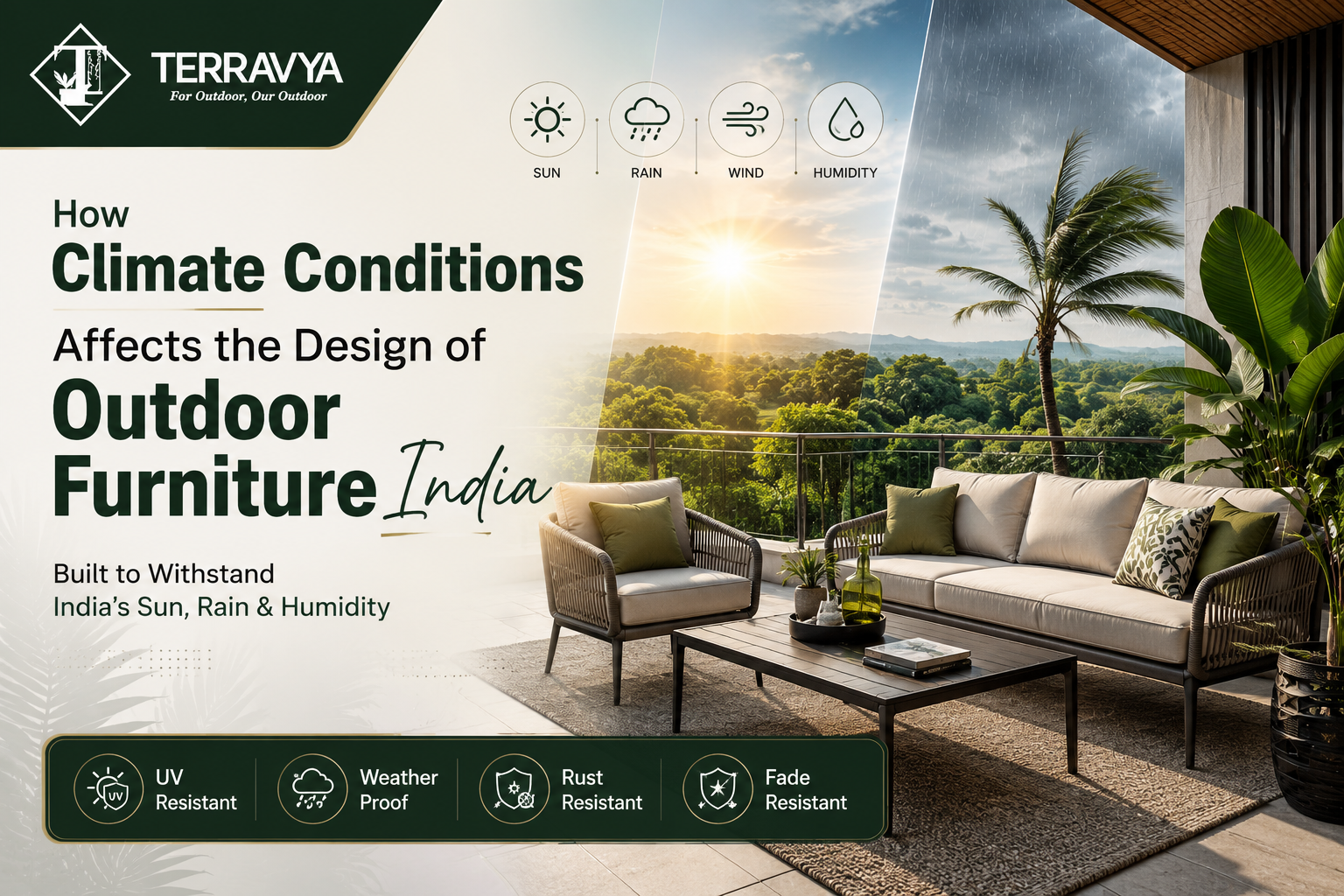
How Climate Conditions Affects the Design of Outdoor Furniture India
I want to share a mistake we did long time ago which I still remember.
We had just finished this gorgeous aluminium sofa for a client in Goa. And I mean gorgeous. Smooth powder coat, wicker tight and even cushions that you sink into. Three months later, the client called. He wasn’t shouting or anything, just… disappointed. There were these tiny orange spots around the feet of the sofa. Spreading, slowly. I was confused. Aluminium doesn’t rust. We asked him to pop off one of the foot caps and look inside. And there they were. Regular zinc-plated steel screws. The kind we’d used hundreds of times without a second thought. In that Goan air — salty, wet, relentless — they’d started to corrode. Rust was bleeding down and staining the leg. The actual frame was perfect. Not a scratch. But that screw, maybe ten rupees at most, ruined the whole look.
That’s the day I really understood. Outdoor Furniture India isn’t something you design in a factory and ship everywhere with the same spec sheet. The place where the piece ends up — the actual climate changes every single rule.
This country doesn’t have one weather. It has six, and they do not go well with each other. The extreme humidity of Kolkata or Mumbai, Dry in Jodhpur, The foggy Coorg for days and the way Darjeeling becomes cold. They each attack your furniture in their own way and character.
Some of it obvious, a lot of it sneaky. Over the years, by building things and watching them fail and fixing them and watching them again, we’ve figured out what climate-resilient outdoor furniture actually means. Not as a marketing phrase. As a checklist of real, practical things. Here’s the messy version of what we learned.
What Different Climates Do to Your Outdoor Pieces
The India Meteorological Department has maps and data and all that if you want the science IMD’s website: https://mausam.imd.gov.in/ is a good place. But from our side, handling returns and talking to frustrated customers, we see the same patterns of damage over and over. Four big ones.
That Salty, Sticky Coastal Air
Live near the sea? Chennai, Kochi, Goa, Mumbai? Your furniture basically lives in a salt mist. Salt particles float in the damp air and settle on everything. Then they wait. Just a small scratch in the paint, or a area where the powder coating got thinner, the attack starts from there. Corrosion start tom build up before you realise. Wood does not have its own oil to soak moisture, it is soaked and mildew in parts which can’t be noticed easily before it grows into large sections. Cushions become a sponge. The foam inside never quite dries, and after a while you get that musty smell that just won’t leave. For coastal homes, there’s no cutting corners. You need genuine climate-resilient outdoor furniture. Materials that flat-out refuse to corrode. Fabrics that shed water fast. Hardware that won’t betray you.
Blistering Dry Heat, Inland
Rajasthan, Gujarat, the drier parts of the Deccan — they hammer furniture with UV and temperature swings that feel almost violent. A dark metal table in the afternoon sun can get hot enough to burn your hand. Solid wood loses its internal moisture. I’ve heard it crack at night, a loud snap when the temperature drops twenty degrees in a couple of hours. Cheap wicker, the hollow PVC kind, goes brittle under that sun. Fades from a nice deep brown to a chalky, washed-out grey in maybe one season. We’ve seen it happen on pieces we didn’t build, and it’s sad. For these zones, you want surfaces that stay cooler, finishes that don’t break down under the solar hammer. Fabric dye has to run all the way through the fibre, not sit on top.
Mountain Cold, Freeze and Thaw
Places like Shimla, Darjeeling, the Nilgiris — they have a quieter, slower problem. Water sneaks into tiny gaps, hollow sections, around joints. Then at night, when it freezes, the ice expands. Pushes outward. Over a winter, that steady pushing can crack a weld or split a wooden armrest right along the grain. You won’t notice it happening. Then one day the joint just gives. Designing for these places means being a little obsessive about drainage. No sealed hollows where water can hide. Everything has to breathe or drain completely. It’s a small detail, but skip it and the piece won’t last.
The Monsoon That Never Seems to End
Most of India sits under a long, heavy monsoon. The Western Ghats, the Northeast, the plains — months of steady rain, high humidity, mud splashing up from the ground. Water sits on flat surfaces, finds its way into end grain, sneaks into screw holes. If a design has even one tiny sealed cavity with a pinhole opening, water gets in and stays there. It rots the material from the inside out. By the time you see anything, it’s too late. Good Outdoor Furniture India for monsoon country sheds water immediately. Slats that let rain drop straight through. Gentle slopes on horizontal surfaces. Hardware that stays rust-free even when damp for weeks. Nothing fancy. Just practical.
Materials That Actually Hold Up (And a Couple We Avoid)
We’ve watched materials age in real life, not just in a lab. Here’s the honest, short version.
Teak wood is still the easiest hardwood to live with outdoors. Its own natural oils keep water and bugs away. We’ve seen teak benches near the Kerala backwaters — fog, monsoon, everything — still solid after ten years with just a yearly oiling. It costs more. But you get peace of mind back.
Aluminium with a thick, UV-stabilised polyester powder coat is just steady. Doesn’t rust. Lightweight. The finish stays good for years. We use it for frames across almost everything. And after that Goa screw disaster, we switched to stainless steel hardware everywhere. For coastal orders, we slip nylon washers between different metals. Stop that strange corrosion that happens when two metals touch in salty air. Tiny change, massive difference.
High-density polyethylene wicker, HDPE, took us a while to trust. Plastic wicker? Really? But the good stuff, the heavy kind with a bit of texture, isn’t like the cheap hollow PVC. It doesn’t fade or snap. Rain runs off it. Sun doesn’t bother it. We left a sample on a Jodhpur roof for a whole summer. It came back looking exactly the same. The PVC sample next to it was wrecked. HDPE is now a core part of our **climate-resilient outdoor furniture**.
Cushions? Solution-dyed acrylic or polyester. The colour is inside the fibre, not painted on. Quick-dry open-cell foam inside. You can soak it, and it’ll drain out and be damp but usable in no time. That’s a lifesaver when a sudden shower catches you off guard.
| Material | Best Suited Climates | Key Advantage | Maintenance Requirement |
| Teak Wood | Coastal, monsoon | Natural oils repel water, high stability | Annual oiling; clean grain |
| Aluminium (powder-coated) | All climates | Lightweight, rust-proof, UV-resistant coating | Wipe with damp cloth |
| Stainless Steel (304/316) | Coastal, humid | Exceptional corrosion resistance | Occasional wash to remove salt |
| HDPE Wicker | Arid, mountain, monsoon | UV-stabilised, colourfast, moisture-proof | Brush clean; no rotting |
| Acacia Wood | Dry interior zones (under shade) | Budget-friendly hardwood | Requires sealing, periodic oiling |
| Fabric (solution-dyed acrylic) | All climates when properly designed | Mould-resistant, quick-dry, fade-proof | Spot clean; store cushions in heavy monsoon |
Design That Bends Around the Weather
Picking the right material is half the work. The other half is how you put the thing together. Honestly, the biggest mistake I see in outdoor furniture is terrible drainage. A beautiful, perfectly flat tabletop photographs well. Put it outside in a Mumbai July, though, and it’s a pond. We slope or slat every surface we can. Armrests, little shelves, everything. Seat pans get weep holes. Wicker weave has tiny gaps so air moves through and dries the back side. It’s quiet, unglamorous engineering, but it’s what keeps the piece alive.
Weight matters more than most people think. If a sofa is a struggle to drag under cover, it’ll get left out in a sudden hailstorm. Wet cushions, frustration, damage that didn’t need to happen. Our aluminium frames are intentionally light. One person can usually shift them. That tiny bit of flexibility adds years to the furniture’s life. Simple.
We Test in Real Places, Not Just a Lab
Yeah, we have a weathering chamber. It blasts UV and salt spray at samples. Useful for quick comparisons. But it doesn’t tell you everything. So we also put prototypes out with team members who live in different climates. A wicker chair sat on a windy Chennai terrace for six months, getting pounded by salt air. A teak table stood in a Coorg garden through a full monsoon, half under banana leaves. A metal bench baked on a Jodhpur rooftop day after day. Those pieces came back carrying lessons no machine can give. How water dribbles down a certain curve. Where dust likes to collect. How burning hot a dark frame gets at 2 pm. All that stuff gets folded into what we now call Outdoor Furniture India ready. It’s not clean or scientific-looking. But it works.
A Little Bit of Looking After
Even the toughest furniture likes a bit of care. If you’re near the coast, hose things down once a month. Washes the salt off before it can sit and do damage. Dusty area? A quick wipe with a damp cloth stops grit from scratching the finish. Monsoon time, tilt your cushions on their sides after a heavy spell so they dry all the way through. Check that the drainage holes aren’t stuffed with leaves. Good breathable covers are worth every rupee when you’re away or when extreme weather is coming. And once a year, grab an Allen key. Tighten bolts. Look at the joints. Takes five minutes.
Frequently Asked Questions
What outdoor furniture really survives near the sea?
Aluminium or high-grade stainless steel frames. Teak or HDPE wicker. Stainless steel hardware — never zinc-coated stuff. Fabrics that say solution-dyed and mould-resistant. Keep mild steel far away; it’ll rust even through paint.
Can I leave outdoor furniture out the entire monsoon?
If it’s built right, with drainage and rust-proof materials, yes. But pulling it under cover or using a waterproof cover during the absolute worst downpours will definitely stretch its life.
Is there a real difference between cheap wicker and expensive wicker?
Massive. Cheap wicker is usually PVC. Fades, gets brittle, can even go soft in extreme heat. HDPE wicker stays strong and colourfast. You can feel the difference when you hold it — heavier, denser, not hollow.
Do I need to oil teak every year?
Only if you like the warm golden-brown colour. If you let it go, teak turns a soft silvery grey that a lot of people actually prefer. Structurally, it stays sound either way. Your call.
How can I tell if a powder-coated metal frame is good?
Ask the brand about coating thickness. For outdoors, 60 to 80 microns is a solid range. A maker who knows their stuff will have the numbers ready. We do, because we’ve put ours through salt spray tests and real coastal air and it holds up.
The Main Thing
Your terrace or garden isn’t a showroom. It gets wind, rain, dust, sun — all of it. The furniture you put there should get that. We build Outdoor Furniture India with all this climate madness in mind, not as an afterthought. Every piece carries the lessons from that Goa screw, from the Jodhpur rooftop, from the Coorg garden. We stand behind them because we’ve seen what they can take.
Have a look around https://terravya.in/ and see what’s there. Or just reach out and tell us where you live. We honestly enjoy talking about this stuff, and we’ll help you pick pieces that feel right at home in your weather.
Written by: Design Team, Terravya
The design team is the mind behind everything Terravya gives to the community whoi like to transform their boring outdoors into a haven of comfort and elegance.
Published: